Pages

Showing posts with label Anne Hardy. Show all posts

Monday, 26 March 2012

The Commission - My Research: Anne Hardy

Anne Hardy's photographs of constructed sets of unusual interiors is what she is primarily known for. This work of hers consists of items and furniture which she has collected from places like markets and jumble sales or skips - second hand, and arranged within her studio and then photographed. In this sense, she relates very well to the subjects within my series because there are links evident (in both her photographic choices and with my series) with the population and the second hand market.

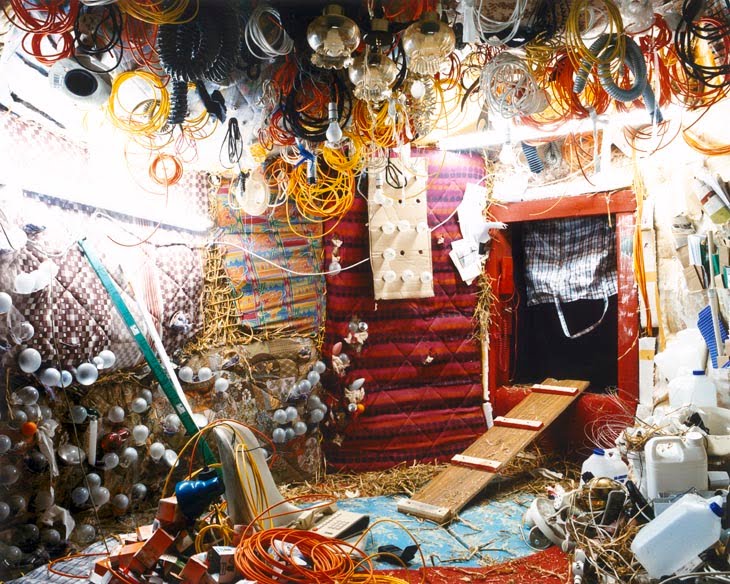
Cipher
Aspects in some of Hardy's work such as in Cipher, provide a painterly and atmospheric aesthetic. This is achieved by the hazy glow being produced by the fluorescent lights; the " faux grotto" walls; and the differing levels of the hanging ropes having an effect spatially upon the room. These aren't just objects found carelessly on the street and thrown into a room together to produce something that could look kind of cool. They are carefully considered objects being places appropriately with each other to create a style which is then complimented with the decoration and technical choices Hardy makes. They are works of art. Hardy often admits to reshooting her images, even if the changes made is moving an object by centimetres.

*** 

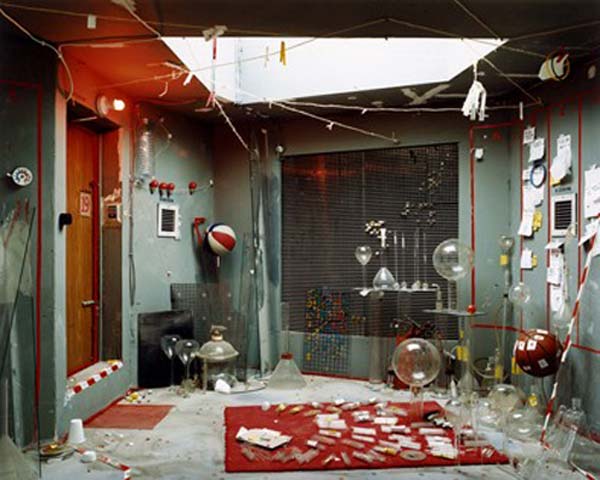
Prime

This second image including the skylights relates well to my choice of using natural lighting because of how the source of light in her work is intended to, and does a very good job of looking like natural daylight. It further evokes the feeling of the set being a regular but just unusually adorned room, which in reality, it is not.

***

Untitled VI

In an article on 'The Guardian' called "Anne Hardy's best shot", she speaks about an image of hers she particularly likes from 2005. Her sets built in her studio are centred around the camera so it is more photography related than an installation. She used a medium format camera, like I chose to do, and a wide angle lens which makes sense to photograph a whole "room". I used a standard lens however, as I was only photographing certain scenes in a room.

***

A major similarity between mine and Anne Hardy's work, is that  it somewhat showcases the second hand market. Although Hardy uses a lot of small objects and waste in her images to fill up the room, she also uses furniture and larger objects - this is where the second hand market comes into it and more specifically; it's availability.

Through her printing method Hardy gives the viewer of the image a sense of looking into the room. This is aided by the inclusion of so much of the space and objects in her photograph - namely, her choice of a wide angle lens.


References:
http://www.guardian.co.uk/artanddesign/2007/jan/11/photography.architecture
http://www.saatchi-gallery.co.uk/artists/anne_hardy.htm

Wednesday, 22 February 2012

Research Task: Laura Dack's research for my project

Concept: the lack of a recession for the second hand market and the availability of hand-me-down products

ANNE HARDY
Hardy’s work is constructed within empty spaces, repopulated with sourced second hand furnishings and objects that reanimate the ‘room’ into discombobulated, dystopian environments. The lack of displayed human interaction leaves us to create how the rooms came to be how they appear, rendering their disorientating appearance ‘dreamscapes’. Her images appear painterly, as they are constructed to be viewed purely from the camera’s vantage point, producing a purely two-dimensional environment. The images will always appear unreal or fabricated, yet the scenes depicted still ‘possess’ the space.

In looking at her work, the concept of using an object from someone else’s life to create a new pictorial one springs to mind. Second hand objects carry with them a story of their past ‘life’ and in creating new images with them it carries on both their legacy and their function. Reusing furniture reduces waste that has been created by fly-tippers, but can be used to a similar visual effect, as if they have been dropped into the scenes.

Detatched, 2009
Cell, 2004
Untitled VI, 2005


MARIO CAICEDO LANGER
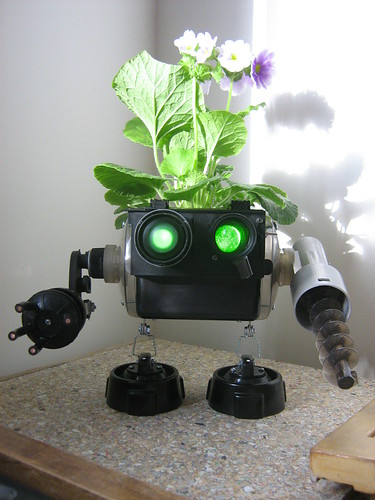
Langer works with broken gadgets, scrap metal and other unwanted waste to create a series of cyborg-style sculptural creations. He reuses a common waste product due to the vast increase in electrical consumerism and consumption in the past thirty years. The forms he creates take items that would otherwise take a lot of energy to melt down into bi-products and reform, and creates new products that can be reused in their reincarnations.

Langer’s art inspires ideas of using found, ‘unneeded’ or refused objects to create something functional once more, such as ornaments as he did, or other items such as furniture. 

Tin Man, 2009
Robo-Planter, 2011


MATT WAIN
I came across this commercial photographer when researching photographers who shoot portraits of people in their personal environments. I was drawn to using his work as an example in this research as in these shots the use of the environment expresses the idea that people have a relationship with furniture and visa versa. This made me think about the change that occurs to cast-off or second hand furniture that is bought or collected; does it lose its story/surface memory when passed from one person to another, and how does it reincorporate itself into a new environment.

Obviously the furniture in his images doesn’t suggest they are second hand but it is relevant to the portraiture theme of the project to see the relationship between subject and environment. From this I personally would be inspired to photograph the homes of those who collect second hand furniture but, unlike the work of Anne Hardy, I would have the subject in the image to draw parallels between the furniture and the owner, suggesting the personal relationship between them.


KATIE THOMPSON
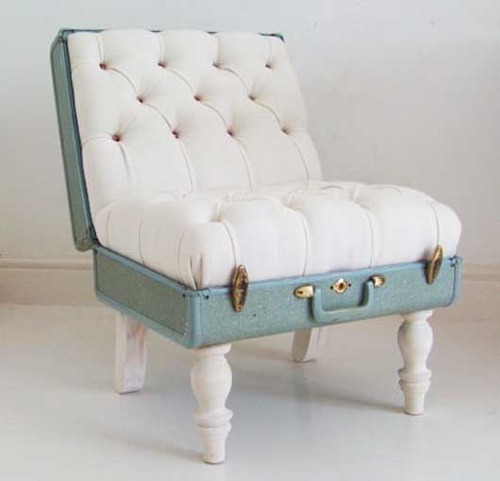
Thompson is a South African designer who fashions furniture from recycled objects, such as old suitcases, buckets and umbrellas. The pieces she creates have a vintage finish to them, showing that recycled goods can seem upmarket and need a second glance to notice why they have a quirky edge to them, rather than old rusty objects cluttering up gutters. The concept of recycling objects before they decompose or lay waste in a rubbish dump is a fast growing concept and many boutiques offer these kinds of products.


My research has inspired me to come up with an idea to collect objects from people I know and from fly tipping that are no longer wanted or needed to craft a new environment in a studio. Although overly ambitious, this is what my visual concept would start out as:

I would use these objects to reconstruct either a 360˚/270˚ scene of a room, or multiple single vantage point scenes of a room, and photograph various parts of the scene to create various narratives about the suggested inhabitant of the scene. I would construct furniture in the style of Katie Thompson, by using bits of furniture and other objects. I would be tempted to pastiche the dystopian backdrops of Anne Hardy’s work and also her use of hanging objects to fill the room so that no part of the image(s) is empty.  

If I were to create just one scene, I would shoot it from various angles with a shallow depth of field focusing on the key item in each image, which I would intend on basing a story around.

If three separate scenes were created, I would shoot with a large depth of field to emphasise the sheer amount of objects, as I would aim to cram a lot into one area, creating jumble heaps, much like scenes in the movie Labyrinth in the junk yard where children’s forgotten things end up.

I would light it with the studio’s own continuous overhead tungsten lighting and use a softbox flash, to recreate interior lighting and a natural light source like a window to highlight some objects, possibly coming through a fake window.


Tuesday, 7 February 2012

'Waste' Brainstorming and Initial Ideas

Brainstorming ideas for our current 'Waste' project

After our lecture about our new project in which I took down general notes about waste, names of photographers linked to photographing waste and some definitions of the word, I put these together in a diagram along with some random ideas I could use for the project.


Through writing down all my notes and additional research I did in one place I was able to look at it all together and draw links between things which I have highlighted in yellow. I also highlighted the photographers who's work I admired the most.


How I came to my idea...
I considered waste more metaphorically like 'a waste of space' or a 'waste of time' and considered finding uncultivated land to take a series of landscapes of which could be given more purpose; it being a waste of space just as it is.

While also planning on going to my local tip and photographing the organisation of waste and recycling I suddenly imagined an empty field accompanied by a living set up - an old sofa and chair, old television and rug etc., some things which you might find in a tip that people have got rid of for whatever reason. They will be arranged as if they are in a real room and they are in use but there will be no physical room (no walls, roof or floor). A set made up of things people discard because they don't want them anymore despite the fact they can still serve a purpose. I want the significance of them being out of place - in a field - to represent how things can be put to use somewhere else if they are unwanted in one place, no matter where. Taking the objects out of context highlights how their purpose is versatile. "One man's trash is another man's treasure" after all. This also links well with the fact that waste is directly linked to human development.


Visual references and inspiration
I wrote down the names of the photographers we had been advised to look at concerning waste as a theme when I first started brainstorming. I particularly liked Anne Hardy's constructed rooms of things she had collected; deemed 'waste' by others. However, I thought recreating something similar would take too long and for this reason would not be a wise path to take. Her photographs are a particular visual reference as I aim to do a similar thing but outside a room and with more solid objects but less collectable things.


Other concepts I was interested in
I thought about using recyclable objects or general scrap to build something useful - something like a dog kennel, and photograph this. This would show the versatile aspect of things people throw away.

I also liked the idea of 'waste' being defined as a noun, particularly: "to wear down or reduce in bodily substance, health or strength" which considers the idea of waste more metaphorically.