Pages

Showing posts with label waste. Show all posts

Monday, 26 March 2012

The Commission - My Research: Anne Hardy

Anne Hardy's photographs of constructed sets of unusual interiors is what she is primarily known for. This work of hers consists of items and furniture which she has collected from places like markets and jumble sales or skips - second hand, and arranged within her studio and then photographed. In this sense, she relates very well to the subjects within my series because there are links evident (in both her photographic choices and with my series) with the population and the second hand market.

Cipher
Aspects in some of Hardy's work such as in Cipher, provide a painterly and atmospheric aesthetic. This is achieved by the hazy glow being produced by the fluorescent lights; the " faux grotto" walls; and the differing levels of the hanging ropes having an effect spatially upon the room. These aren't just objects found carelessly on the street and thrown into a room together to produce something that could look kind of cool. They are carefully considered objects being places appropriately with each other to create a style which is then complimented with the decoration and technical choices Hardy makes. They are works of art. Hardy often admits to reshooting her images, even if the changes made is moving an object by centimetres.

*** 

Prime

This second image including the skylights relates well to my choice of using natural lighting because of how the source of light in her work is intended to, and does a very good job of looking like natural daylight. It further evokes the feeling of the set being a regular but just unusually adorned room, which in reality, it is not.

***

Untitled VI

In an article on 'The Guardian' called "Anne Hardy's best shot", she speaks about an image of hers she particularly likes from 2005. Her sets built in her studio are centred around the camera so it is more photography related than an installation. She used a medium format camera, like I chose to do, and a wide angle lens which makes sense to photograph a whole "room". I used a standard lens however, as I was only photographing certain scenes in a room.

***

A major similarity between mine and Anne Hardy's work, is that  it somewhat showcases the second hand market. Although Hardy uses a lot of small objects and waste in her images to fill up the room, she also uses furniture and larger objects - this is where the second hand market comes into it and more specifically; it's availability.

Through her printing method Hardy gives the viewer of the image a sense of looking into the room. This is aided by the inclusion of so much of the space and objects in her photograph - namely, her choice of a wide angle lens.


References:
http://www.guardian.co.uk/artanddesign/2007/jan/11/photography.architecture
http://www.saatchi-gallery.co.uk/artists/anne_hardy.htm

The Commission - My Research: Alex Soth

"I fell in love with the process of taking pictures, with wandering around finding things. To me it feels like a kind of performance. The picture is a document of that performance".

Alex Soth expresses the need to tell a story through his photography and express the narrative but admits he struggles to do so. "Photographs often leave me feeling like something is missing". This is almost like what I wanted to do with my photographs - tell a personal story.

It is an opinion that the best photographs inspire curiosity rather than satisfy it and I believe I may have achieved this is my series with the simplistic framing and the subtle use of money that will make people wonder what the significance of it is. Hopefully people will look at my series and want to know what the significance of the people in their locations are too and their link with them, and in turn, understand the context. I think this is also a similar element in Soth's work. For example, his photograph below, of an older male next to what looks like a cabin holding a model aeroplane in each hand.

Soth talks about how the house caught his eye. He went and enquired and met the man's wife who told him that he had in fact build the house. She also explained how Charles and his daughter built model planes in the room he called his 'cockpit' on the 4th floor entered via a ladder. The room was small and lined with windows; too small to photograph in. The photograph is taken on the roof.

 'Charles, Vasa, Minnesota 2002'

This image provokes my interest (just as Alec Soth talks about this house and the people provoking his) and there also seems to be some juxtaposition between the apparent age of the man and the fact that his hobby is often also shared by children.

The isolation of the subject relates to how I have chosen to frame my subjects with a shallow depth of field. Although the second hand items are important in my series and to my concept, the concentration on the subjects is to give it context and I chose to do this to make it personal.

***


This image of Soth's would have been a perfect visual reference for my concept had I pursued my first idea about photographing a constructed set in a random location.

***

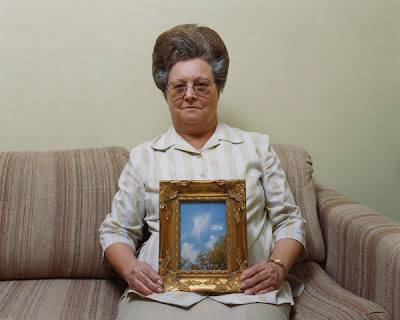
Two visual references of Alec Soth's which I found inspired my photographic choices are the portraits below of the women in what seems like their homes. They seem to suit the colour tones in the rooms. It is their posture and their relationship to the camera which I have recreated in my own series as well as their natural expressions and contexts within the photographs.


References:
http://www.seesawmagazine.com/soth_pages/soth_interview.html

Thursday, 22 March 2012

Critical Appraisal: The Commission (300 words)

My series is about the availability of the second hand market and the advantage of having it in our current economy as well as the anonymity behind is context. My series is based around perfectly good furniture and objects which have become waste to one person but are appreciated by others; one mans trash is another mans treasure. I feel my work would sit best in an exhibition.

My understanding of the issues of waste is that it is generally a negative thing but has many different definitions. Waste can be positive: recycling; compost; the second hand market. I wanted to demonstrate a positive outcome of the issue.

To begin with I wanted to photograph a constructed set after being inspired by Anne Hardy’s work (my research here) but abandoned this idea because I felt it lacked depth. Then I decided I wanted to make portraits with a more personal touch. I looked at Alec Soth’s work (my research here) and aspired to recreate the subtle tones, square aesthetic and precise framing in my own series. I also spent some time researching the second hand market’s advantages and popularity found here. 

I chose to utilise natural lighting giving a more personal feel to my images. I used ISO 160 film for clarity and used a shallow depth of field to focus on either the faces of my subjects or the significant object and to demonstrate the personal essence in my series.

I managed my studies by taking two photographs and printing these, then re-shooting the other I took at an earlier stage - having already discarded the print. This way I worked well with two images and then concentrated on matching my last to fit the series (contacts and prints here) Time management is the most challenging aspect and to overcome this I need to plan each movement for future projects.

Friday, 9 March 2012

The Commission: Contextual 'Waste' project research and developments

I decided to do some more contextual research into the benefits of the second hand market and discovered another very important layer to my concept. Recycling furniture through the second hand market benefits not only the people involved but the environment. This is because the use of resources in manufacturing new furniture is reduced and therefore less "waste" is produced. So not only are people finding a home for second hand furniture considered waste to some, but they are stopping the necessity for the disposal, recycling and process of it becoming technical waste.

A also looked more into the links between the second hand market and our current economic status as I want to make a comment about this. Freecycle is a website devoted to allowing the exchange of second hand items.

"The worldwide Freecycle Network is made up of many individual groups across the globe. It's a grassroots movement of people who are giving (and getting) stuff for free in their own towns. Freecycle groups match people who have things they want to get rid of with people who can use them. Our goal is to keep usable items out of landfills. By using what we already have on this earth, we reduce consumerism, manufacture fewer goods, and lessen the impact on the earth. Another benefit of using Freecycle is that it encourages us to get rid of junk that we no longer need and promote community involvement in the process."

By October of 2008, the number of internet searches in the UK consisting of the words 'second hand' had increased by 22% in a year. Cars, books and furniture are among the top listed. People realise that they can save money and help the environment by purchasing second hand items and this is what I want to display in my series.

***
  • My selection of the furniture in my images will hopefully lead viewers to realise the nature of them because they won't look like the new, perfect, modern products selling now - they are not newly bought or made.
  • The way in which I frame and compose my portraits will also hopefully draw emphasis to the furniture, and therefore their appearance and showcase it well. My subtle use of money (present in the image but not in sharp focus) will emphasis the economic benefit.


References:

  • http://www.kimberlymichaudinteriors.com/kami-online-design-services-0
  • http://uk.freecycle.org/
  • http://weblogs.hitwise.com/robin-goad/2008/10/second_hand_goods_classifieds_freecycle.html

Thursday, 23 February 2012

'Waste' Concept Update

Thought Management
Having received research from my partner from the Commission seminar task, it made me think a lot more about my idea. Anne Hardy, Mario Caicedo Langer, Matt Wain and Katie Thompson are among the artists related to my initial concept of the lack of recession for second hand buyers and how second hand products which are waste to one person are useful and loved by another.

I looked at Anne Hardy's constructed sets in relation to my very first original idea of photographing a living set up of second hand furniture placed in a random location. However, I felt this concept lacked depth because despite the location representing it's purpose in one place when it has been discarded from somewhere else, it still seemed much too random and not considerate enough. This idea would also lead to with difficulties of finding location and transport, and most importantly, the whole room of second hand furniture.

Then I considered the idea of making something useful from waste products - recyclable materials and scrap metal etc. This is exactly what Mario Caicedo Langer does; constructing ornaments or furniture and turning the theory of 'waste' around into a more positive subject along with Katie Thompson who transforms objects. I would have liked to experiment with this idea but didn't want to risk choosing it solidly for my concept in the danger that I would not be able to produce something of value to photograph and especially in enough time.

Conclusion
Then I really decided I wanted to focus on second hand furniture because I have a tie to it and wanted to portray a personal message through my photographs. My family have always purchased second hand furniture because it has been the best and most cost effective choice for our lifestyle. I want to portray the advantage of buying second hand and in a sense, how there is no recession for second hand buyers because the economy does not affect them in the same way it does others.


So a summary of my concept would be the availability of the second hand market and the advantage of having it in our current economy and the anonymity behind it's context; one mans trash is another mans treasure.


Visual choices
I am still playing around with a few visual ideas for my series - the composition and framing mainly and how each image in my series will work together because I want them to flow really well. This is something I failed to achieve in my last two series I presented for the Environment projects. 

My new idea is to take a set of portraits of second hand buyers with their furniture. For example, I visualise each person to be sitting and looking straight towards the camera. I have decided I will use medium format colour on my Hasselblad 500 c/m and isolate my subjects with their objects with a very shallow DOF.

I am also considering involving the subtle presence of money. For example, a small pile of notes sitting on the lap of each of my subjects. This brings in the economical advantage to buying second hand and brings a new level to my concept. I feel there would be something lacking without the presence of this, especially as the idea of second hand furniture in itself is strongly linked to money in general. I have also thought about somehow labelling the furniture with it's price which will be low and therefore give some indication to it's context and how it was not brought new. I need to go about this very carefully though as to keep the image subtle, natural and classy.

I also want to experiment with including my dog in my series who we rescued from a dog home (and in that sense is second hand) but I do not know if I want to take it that far yet.

I like Alec Soth's almost minimal style and the muted tones. The posture and pose of these subjects as well as the context of them is something I'd like to incorporate into my own series although the lighting in my images will hopefully be slightly warmer.


Planning
I would have liked to visually explore my previous ideas more, but instead I allowed myself a lot of time simply for thought and working out how they would work in my mind which is how I work comfortably. As well as this, my previous ideas are not something I could have easily and quickly have explored because they would have taken time and organisation to photograph and all to possibly just discard the idea which I would not have had time to do.

I intend to shoot at least one roll of film this weekend to experiment with how each of the elements I want to include will look. What I can make work. What I need to leave out of my series. One of the images I want to include will be taken in my own home where we have an abundance of second hand subjects and very beautiful natural light every now and again which I want to really take advantage of.

Images to come...

Tuesday, 7 February 2012

'Waste' Brainstorming and Initial Ideas

Brainstorming ideas for our current 'Waste' project

After our lecture about our new project in which I took down general notes about waste, names of photographers linked to photographing waste and some definitions of the word, I put these together in a diagram along with some random ideas I could use for the project.


Through writing down all my notes and additional research I did in one place I was able to look at it all together and draw links between things which I have highlighted in yellow. I also highlighted the photographers who's work I admired the most.


How I came to my idea...
I considered waste more metaphorically like 'a waste of space' or a 'waste of time' and considered finding uncultivated land to take a series of landscapes of which could be given more purpose; it being a waste of space just as it is.

While also planning on going to my local tip and photographing the organisation of waste and recycling I suddenly imagined an empty field accompanied by a living set up - an old sofa and chair, old television and rug etc., some things which you might find in a tip that people have got rid of for whatever reason. They will be arranged as if they are in a real room and they are in use but there will be no physical room (no walls, roof or floor). A set made up of things people discard because they don't want them anymore despite the fact they can still serve a purpose. I want the significance of them being out of place - in a field - to represent how things can be put to use somewhere else if they are unwanted in one place, no matter where. Taking the objects out of context highlights how their purpose is versatile. "One man's trash is another man's treasure" after all. This also links well with the fact that waste is directly linked to human development.


Visual references and inspiration
I wrote down the names of the photographers we had been advised to look at concerning waste as a theme when I first started brainstorming. I particularly liked Anne Hardy's constructed rooms of things she had collected; deemed 'waste' by others. However, I thought recreating something similar would take too long and for this reason would not be a wise path to take. Her photographs are a particular visual reference as I aim to do a similar thing but outside a room and with more solid objects but less collectable things.


Other concepts I was interested in
I thought about using recyclable objects or general scrap to build something useful - something like a dog kennel, and photograph this. This would show the versatile aspect of things people throw away.

I also liked the idea of 'waste' being defined as a noun, particularly: "to wear down or reduce in bodily substance, health or strength" which considers the idea of waste more metaphorically.