Thought Management
Having received research from my partner from the Commission seminar task, it made me think a lot more about my idea. Anne Hardy, Mario Caicedo Langer, Matt Wain and Katie Thompson are among the artists related to my initial concept of the lack of recession for second hand buyers and how second hand products which are waste to one person are useful and loved by another.
I looked at Anne Hardy's constructed sets in relation to my very first original idea of photographing a living set up of second hand furniture placed in a random location. However, I felt this concept lacked depth because despite the location representing it's purpose in one place when it has been discarded from somewhere else, it still seemed much too random and not considerate enough. This idea would also lead to with difficulties of finding location and transport, and most importantly, the whole room of second hand furniture.
Then I considered the idea of making something useful from waste products - recyclable materials and scrap metal etc. This is exactly what Mario Caicedo Langer does; constructing ornaments or furniture and turning the theory of 'waste' around into a more positive subject along with Katie Thompson who transforms objects. I would have liked to experiment with this idea but didn't want to risk choosing it solidly for my concept in the danger that I would not be able to produce something of value to photograph and especially in enough time.
Conclusion
Then I really decided I wanted to focus on second hand furniture because I have a tie to it and wanted to portray a personal message through my photographs. My family have always purchased second hand furniture because it has been the best and most cost effective choice for our lifestyle. I want to portray the advantage of buying second hand and in a sense, how there is no recession for second hand buyers because the economy does not affect them in the same way it does others.
So a summary of my concept would be the availability of the second hand market and the advantage of having it in our current economy and the anonymity behind it's context; one mans trash is another mans treasure.
Visual choices
I am still playing around with a few visual ideas for my series - the composition and framing mainly and how each image in my series will work together because I want them to flow really well. This is something I failed to achieve in my last two series I presented for the Environment projects.
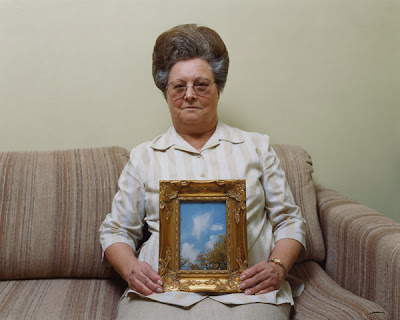
My new idea is to take a set of portraits of second hand buyers with their furniture. For example, I visualise each person to be sitting and looking straight towards the camera. I have decided I will use medium format colour on my Hasselblad 500 c/m and isolate my subjects with their objects with a very shallow DOF.
I am also considering involving the subtle presence of money. For example, a small pile of notes sitting on the lap of each of my subjects. This brings in the economical advantage to buying second hand and brings a new level to my concept. I feel there would be something lacking without the presence of this, especially as the idea of second hand furniture in itself is strongly linked to money in general. I have also thought about somehow labelling the furniture with it's price which will be low and therefore give some indication to it's context and how it was not brought new. I need to go about this very carefully though as to keep the image subtle, natural and classy.
I also want to experiment with including my dog in my series who we rescued from a dog home (and in that sense is second hand) but I do not know if I want to take it that far yet.
I like Alec Soth's almost minimal style and the muted tones. The posture and pose of these subjects as well as the context of them is something I'd like to incorporate into my own series although the lighting in my images will hopefully be slightly warmer.

Planning
I would have liked to visually explore my previous ideas more, but instead I allowed myself a lot of time simply for thought and working out how they would work in my mind which is how I work comfortably. As well as this, my previous ideas are not something I could have easily and quickly have explored because they would have taken time and organisation to photograph and all to possibly just discard the idea which I would not have had time to do.
I intend to shoot at least one roll of film this weekend to experiment with how each of the elements I want to include will look. What I can make work. What I need to leave out of my series. One of the images I want to include will be taken in my own home where we have an abundance of second hand subjects and very beautiful natural light every now and again which I want to really take advantage of.
Images to come...


