Pages

Showing posts with label time machine. Show all posts

Monday, 26 March 2012

Time Machine Essay: Research so far...

I have decided to centre my essay around the theme of beauty and the sublime. I was inspired to write about this specifically through reading ‘Photography: the key concepts’.

"The development of the concept of the sublime as an aesthetic quality in nature distinct from beauty was first brought into prominence in the 18th century in the writings of Anthony Ashley-Cooper, third earl of Shaftesbury and John Dennis, in expressing an appreciation of the fearful and irregular forms of external nature, and Joseph Addison's synthesis of concepts of the sublime in his The Spectator, and later the Pleasures of the Imagination. All three Englishmen had, within the span of several years, made the journey across the Alps and commented in their writings of the horrors and harmony of the experience, expressing a contrast of aesthetic qualities."


Visual Reference: Ansel Adams, "Autumn Moon"

Contextual findings
Yosemite National Park was established in 1890. The park was established to preserve its resources, which make it so unique and attractive, as well as to allow future public enjoyment.

“Yosemite National Park is a world heritage site which has made a significant contribution to California's cultural heritage, to the national park movement, and to Yosemite's 4,000 years of cultural heritage by Native Americans.”

Native Americans populated the national park before it became so, and before Euro-Americans arrived on the landscape.

http://www.yosemite.national-park.com/info.htm
http://www.nps.gov/yose/historyculture/archeology.htm


F64 Group
  • Established in 1932 by Ansel Adams, Edward Weston, Willard Van Dyke, Imogen Cunningham and some others.
  • It deals with the concept of “straight” photography.
  • The group was in response to the "artistic," soft-focus, pictorial type of photography which was popular at the time.
  • Emphasis was placed on "pure" photography, sharp images, maximum depth-of-field, smooth glossy printing paper, emphasizing the unique qualities of the photographic process.
  • The significance of the name lies in the fact that f/64 is the smallest aperture on the lens of a large-format camera and therefore provides the greatest depth-of-field.
  • The members of Group f/64 believe that photography, as an art form, must develop along lines defined by the actualities and limitations of the photographic medium, and must always remain independent of ideological conventions of art and aesthetics that are reminiscent of a period and culture antedating the growth of the medium itself. 
http://kcbx.net/~mhd/1intro/f64.htm


Edmund Burke
As well as being the author of ‘A Philosophical Enquiry into the Origin of Our Ideas of the Sublime and Beautiful’, Burke was a statesman, orator, political theorist and philosopher. Burke believes that the ‘Beautiful’ is what is well-formed and aesthetically pleasing, whereas the ‘Sublime’ is what has the power to compel and destroy us. The transition from the Neoclassical era to the romantic era was marked by the preference from the sublime to the beautiful.

Sunday, 11 March 2012

Time Machine Essay: Visual References

I have decided to centre my essay around the theme of beauty and the sublime. I was inspired to write about this specifically through reading 'Photography: the key concepts'.


"The development of the concept of the sublime as an aesthetic quality in nature distinct from beauty was first brought into prominence in the 18th century in the writings of Anthony Ashley-Cooper, third earl of Shaftesbury and John Dennis, in expressing an appreciation of the fearful and irregular forms of external nature, and Joseph Addison's synthesis of concepts of the sublime in his The Spectator, and later the Pleasures of the Imagination. All three Englishmen had, within the span of several years, made the journey across the Alps and commented in their writings of the horrors and harmony of the experience, expressing a contrast of aesthetic qualities."


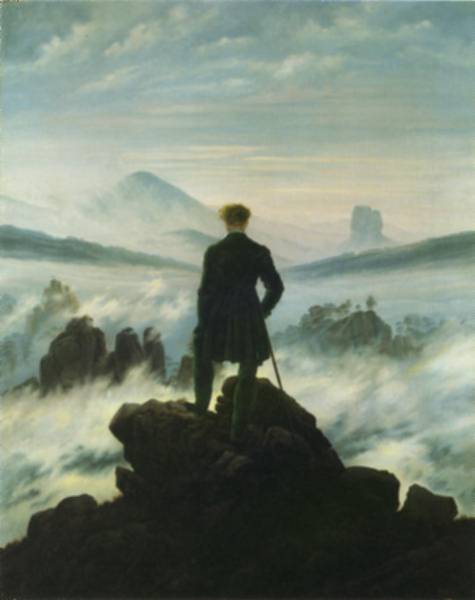
Casper David Friedrich
"Wanderer above the Sea of Fog"
"1818

Friedrich choses to base his landscapes solely on locations in Northern Germany where there are beautiful scenes of scenic trees, hills, harbors, as well as different and atmospheric lighting conditions like misty mornings and other light effects based on a close observation of nature. “Some of Friedrich's best-known paintings are expressions of a religious mysticism."

***

Ansel Adams
"Autumn Moon, the High Sierra from Glacier Point"
1948
"Ansel Adams was a visionary figure in nature photography and wilderness preservation. He is seen as an environmental folk hero and a symbol of the American West, especially of Yosemite National Park. Adams' dedication to wilderness preservation, his commitment to the Sierra Club, and of course, his signature black-and-white photographs inspire an appreciation for natural beauty and a strong conservation ethic."

***

Thursday, 1 March 2012

Time Machine Film Review: Festen

The historical movement of realism in literature and art lasted for about 30-40 years during the 19th Century. It's purpose was "to give a truthful, objective and impartial representation of the real world". Dogme 95 is a process by which film makers follow certain rules when directing; such as no music being added to the film, no extra props, it must be filmed in colour and without special lighting, and the camera filming every scene must be hand held. These are a few of the 10 goals created to "purify" filmmaking. This particular process of filmmaking is very relative to the notion of realism since in the real world we don't hear music and we don't see things in black and white. Therefore imitating how we really live our daily lives through filmmaking complying to the Dogme 95 guidlines, accurately presents us with some truth - though how much is questionable...

Festen, or 'The Celebration' was directed by Thomas Vinterburg. Festen was the first Dogme 95 film, and Vinterburg; one of the founders of the movement. Despite the aim of Dogme 95, Vinterburg admitted to blocking a window in one of the scenes of the film which means two rules were broken - additional props being brought in and the use of special lighting. Furthermore, director Von Trier also used backing music during the filming of 'The Idiots'. The inclusion of these artificial aspects means the representation cannot be argued as a truthful one.

A particular scene in the film interested me. During the celebratory meal where everyone is gathered for Helge's 60th birthday, Christian stands up to make his toast and he suddenly begins speaking of how his father sexually abused him and his twin sister (who previous committed suicide in the hotel where the party is happening). Throughout and when he has finished speaking there is a confused and still atmosphere. The camera films people looking blankly at each other. His father at the head of the table dismisses it. After this scene of the film, it seems the aspect of doubt and confusion surrounding whether or not what Christian spoke of is actually true and how people just disregard it, means that because people can get on with the party, seems to automatically mean it's not true, or 'real'. This is the impression I got from the filmmaking in this case - how it seems that the truth comes out, but life goes on like it is not the truth at all.