Pages

Showing posts with label fashion project task. Show all posts

Friday, 18 May 2012

Fashion Constructed Image: Self Evaluation

How I feel I carried out my roles

My roles within the group were build lead and budget manager. I found it difficult to carry out these roles and feel I would have been much better suited to sourcing props because I enjoy interior design and the creative aspects behind photography. One of the drawbacks of my jobs was that they weren't a constant thing I could work on. 

I made an effort to voice my thoughts about the build when we had test shoots in the lead up to the build week and tried to take an active role in erecting the set when it came to the construction. It was hard to stay on top of the build and direct people when as a group we all got on with it and didn't need a lot of guidance.

When carrying out the role of managing the budget, I produced a spreadsheet involving a list of what we needed with columns for details, cost and who payed for these items; as well as what our total budget was and how much we had spent so far while I was updating it throughout the lead up to the build. We spent a third over our budget which surprised me because I updated the spreadsheet with things I wasn't aware we had bought or even needed for the construction of the set after it was over. I feel there was a big breakdown in communication throughout the weeks we were working on this project. We needed to meet up more often in person to talk about the set build and communicate better with each other as to what moves we were making within the group.

Despite it not being my responsibility within the group, I contributed towards researching and sourcing fashion items. See here.

Fashion Constructed Image: Finding the Fashion


My Contribution

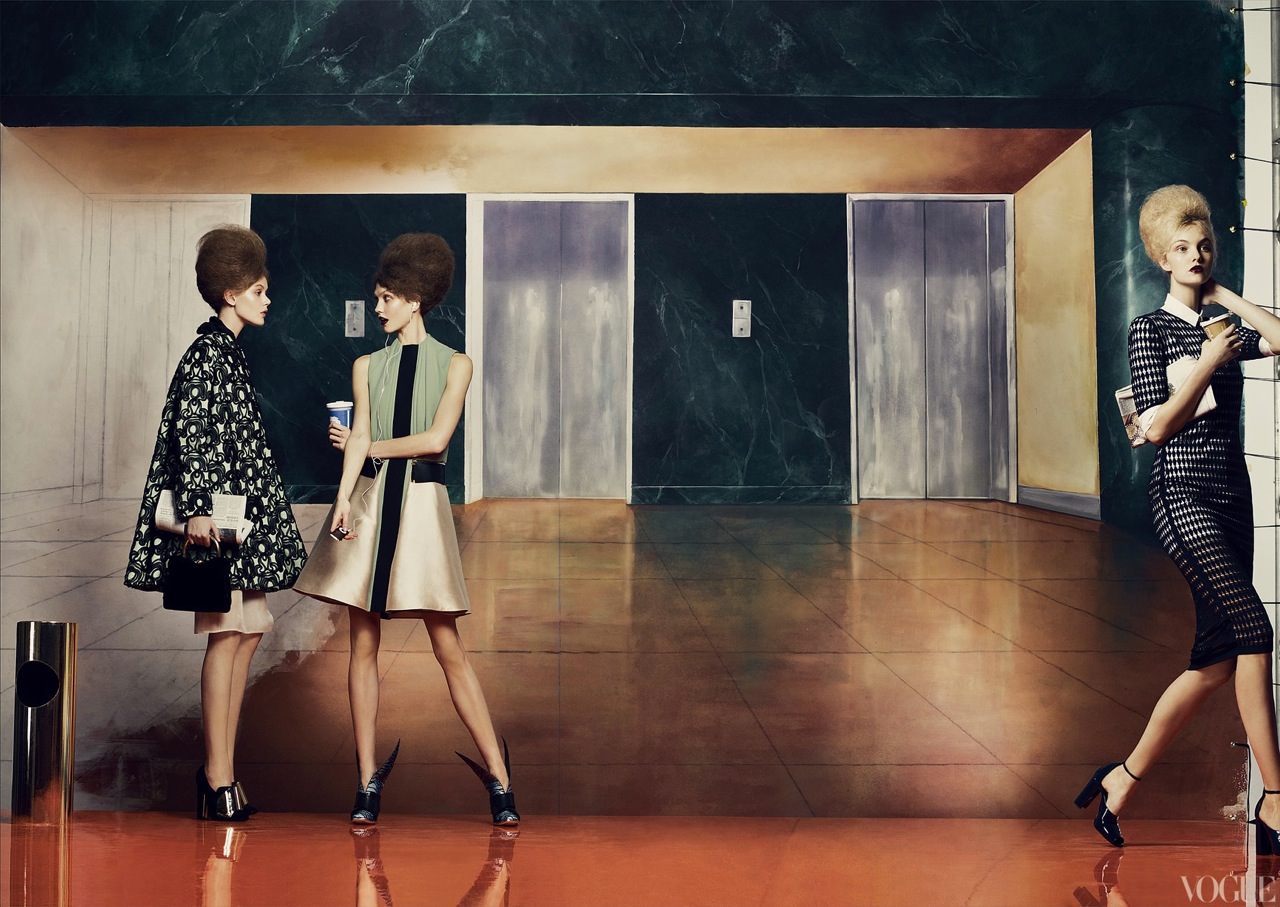
Having been told our constructed fashion image needed to involve contemporary fashion we tried to source clothing from certain retailers in the high street which were based on catwalk styles. We also had some guidance in the form of the following photos to help us find the right outfit for our image.


We can see that the general similarities in these images are long skirts and high necklines and collars. As well as this, there are a lot of neutral tones with some bright reds and blacks but not too much of a variation in colour.

***

While other members in the group were using this as inspiration, I decided to research what the current top trends on the catwalk were and look for clothing on the high street that related to these but which also fit with the classic 50s style; tying in the original with the contemporary to create a generally modern look.

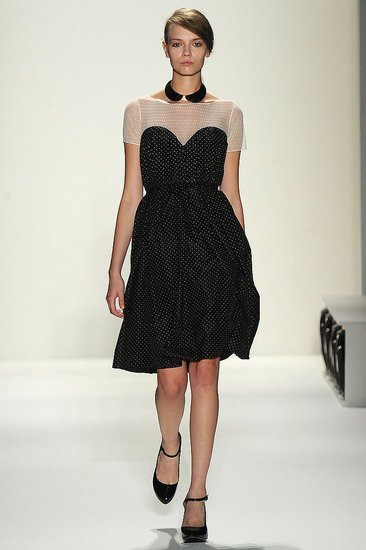
The top few trends of New York Fashion Week (Spring 2012) are bird prints and sheer fabrics of which I found a surprising amount of while out looking. I was also keeping an eye out for the 50s style showing through in modern clothes. Some of the following photos are what I found...


The bird print vests are both very modern styles, however, similar clothes were also found in the 50s - collars, sleeveless, and ties at the hem. They are also made from sheer fabrics. The sheer skirt is knee length as they wore in the 50s. The dress is over the knee and fitted which shows off the woman's figure. This is known as a "wiggle" dress and originated from the 50s. They would also wear short jackets with three quarter length sleeves and I saw a lot of these in the shops I visited, some with round collars.

***

As well as this, while working with my group, I found relevant contemporary dresses mimicking the styles on the catwalk such as:


Wednesday, 16 May 2012

Fashion: Constructed Image: Process of Visual References

We began creating mood boards based around the category of "Film" during the first week of having the assignment. These depicted scenes of films we admired the lighting choices of, examples of film noir, some of Tim Walker's fashion sets, strange and interesting rooms, the theme of exploration which particularly interested Joe Earley, photos of collections I found particularly interesting and some elaborate and even gothic make up styles. Generally, aesthetics we desired.


We displayed these mood boards and talked about them as a group. We discussed going for a similar look to the rooms in the last mood boards - we liked the extravagance and the vibrant colours. We also like Tim Walkers fashion influence upon our mood boards and thought we could work with something like this.

However, upon having differing opinions we began to talk about a set split between a modern and colourful look and a more subtle traditional feel. One of the suggestions was creating a room directly split in half, each half showing a very different picture as well as the model being styled very differently on each side of the body. Two things came from this: the idea of duality, and a reference (Dark City) dealing with the notion of two opposites residing together.

Due to this influence, we then narrowed down our ideas and came up with revised mood boards depicting the psychological aspects of films which also exhibited the idea of duality such as Blue Velvet, Donnie Darko and Fight Club. We also started thinking about the American Dream after exploring films like Blue Velvet and American Beauty thinking about the notion of duality within them.


After this we decided to work with the idea behind the American Dream and focus on the facade behind it. How everything seems perfect but behind closed doors it is a very different story. We thought about what would be involved in our set f we went down this route. We decided fairly early on that we would build a dining room, and have a female model who would be the housewife looking after the home. We created more mood boards from this point focussing more on fashion and character and also the period of the 50s and what the home would look like in this decade. The look of the model became important as we decided we wanted a false look; doll like and awkward.


After this we considered the composition of our photograph and what would be included. Originally we wanted a whole family around the table. However we realised this would cause more difficulties due to sourcing the right models and especially because children would be involved as well as possibly crowding the image.


We then considered the use of mannequins to reinforce the awkwardness and doll-like look to contribute to the false perfection behind the concept of the American Dream. From this we ended up researching the aesthetics of the Nuclear Towns designed for experimentation and analysis of the effect of nuclear bombs in which mannequins were used.


These are what we used as our final visual references to achieve the right aesthetics for our concept having developed from all the influences we had from the beginning and honed in on what we felt was strong. We tried to make our set look like a real home, just as the nuclear homes were designed t seem real and why mannequins were placed within. Having been unable to source a mannequin we directed our model to seem fake, like a doll or a mannequin with awkward limbs and a strange posture with a distant gaze.

As well as this, we wanted to involve the outside with the interior and we used these photographs as inspiration and references for creating a similar look in our set with the juxtaposition between this strange occurrence - sand entering the house from the desert with what is seemingly normal and everyday life for the housewife.


Monday, 20 February 2012

Fashion: constructed image - Our Concept (updated)

Originally written by Joe Borsos.

For our constructed image we decided that we wanted to look at the element of duality. We started with this idea so that we could construct a more complex narrative to portray interlaced binary opposites. This lead us to construct our narrative around the ‘American Dream’.

The concept of showing this idea of a duality to the American Dream, is to use the stereotypical signifiers of the ‘perfect American lifestyle’ but our narrative would subtly also portray the extreme ‘dark side’ to this concept of ‘American Perfection’.

The visual focus of this shoot will be tailored predominately to the 1950’s America. We made this choice as the high point of the American Dream and it’s most iconic propaganda campaigns are post world war II, starting in the late 40’s and 50’s.

Our set build will be of the typical 1950’s family dining room, as the dining room is the heart of the family life. It is where the family meet every day, to share their home cooked meal and bond together.
Looking at the concept of ‘Blue Velvet’, there is the idea that behind the white picket fence, past the perfect mowed lawn, there exists an incredibly dark and twisted life that is hidden from the world behind this mask of consumerism.

Our narrative will look at the American mother, as the mother is the one that keeps the house clean and in perfect order and prepares the meal to hold the family together. Our perfect American mother however, will be replaced by a lonely woman gone insane and delusional through her obsession with the ‘American Dream’; desperately attempting to pursue this. She has set up the full family dining room ready for dinner but she has no family. She has masked herself and life in the products of the American Dream to the extent where even her skin and posture will appear fake, and constructed, to show a loss of the human side to this consumerists’ dream.

Looking at other films like ‘American Beauty’, ‘The Truman Show’ and ‘Fight Club, we wish to take their concepts of obsession with possessions, with the material objects, and in this action the possessions consume the consumer, and they lose sight of meaning in their self identity until they are no longer human. Another visual and concept film reference is 'Donnie Darko' for it's physiological aspects much like that of 'Fight Club'.

We will move away from the concepts of photographer’s like Gregory Crewdson and take elements of the lighting concepts of Finaly Mckay, where everything is lit meticulously to eliminate all shadows, making the person appear plastic.

Tuesday, 7 February 2012

Fashion: constructed image - Our Concept (Film)

Since being assigned the brief for our constructed fashion image project, we have been developing our idea and researching concepts for a week now.

We spent 2 days producing A2 mood boards full of visual references that related to our chosen category - film. We had a range of images involved in our findings from black and white surrealist film stills to fashion images of Tim Walkers' to a number of images involving hoarding and collections dealing with the obsessive side of personalities. Having such a vast range of references was good and bad. We had a bigger choice but then we had to narrow it down a lot to what we really wanted our image to be about.

Upon displaying our presentation on Friday, we have realised we still need to make a lot of decisions about our narrative, aesthetics and the general photographic choices we will employ for our final image. We will also refine our idea, which is explained in our presentation below:

video coming

Thursday, 26 January 2012

Fashion: constructed image - Task 2

Task Two
Carry out a simple 'street' casting of a chosen character or model.


I chose to photograph my brother for this task. I felt taking his portrait rather than a strangers was a better decision based on portraying the person's character. I placed my model in relative context - outside a music shop. This fit in very well with his own choice of music-related branded clothing and (with a deeper understanding of his character as I have) the fact that he is a musician.

I am inspired by his look through our shared love of music and instruments.

Most importantly, I have showcased a character who rests outside of what the mainstream media may consider the norm, as the brief describes, and what I relate to more so than mainstream fashion.

Fashion: constructed image - Task 1

Task One
Research, analyse and deconstruct what you consider to be an 'iconic' fashion image.


Barry Lategan

"Twiggy sat in front of the lens and I said "Wow!" At just 16, she was self possessed and not at all shy for a girl new to the camera."


I have chosen this black and white photograph of Twiggy for the task. The reason I feel this is an iconic fashion image is because I feel for the photograph itself to be iconic, it must feature an icon - Twiggy is best recognised as a great fashion icon of the 60's, and therefore she makes this photograph an iconic fashion image. It is also the most famous photograph of her.


Characterisation
Lategan, who met Twiggy first hand, describes her portrait as conveying "acceptance, approval, acknowledgement." He was surprised by her young age and her confidence in front of the camera.

Props
The use of props has been avoided due to the fact that it is not a full portrait of the model. No props are required due to this being only a head and shoulders portrait.

Clothing
The model wears (from what we can see) a simple looking garment but with a complex fair isle design which seems a juxtaposition. The repeated pattern and simple neckline first draws attention from an audience but does not distract from the model herself too much. Any additional clothing, such as a hat or hair piece would impinge upon one of the models most famous features - her short hair.

Hair and make up
Other elements of her appearance that the model was well known for were her big eyes and long eyelashes - part of her androgynous look (a combination of male and female characterisations). In this photograph this is evident with the use of very dark, long separated false eyelashes and eyelashes painted on which emphasise her large eyes. They stand out against her pale skin and the dark eyeshadow applied in the creases of her eyelids emphasise their size even more. Other than her eye make-up she seems to be styles quite naturally - nothing on her skin or lips.

Her short hair cut into a crop has been styled smoothly with a side parting on her left side. The short length, shine, and lack of further styling does not distract the viewer from anything important but seems a contrast to the complexity of her clothing design.

Lighting and photographic techniques
Lategan talks of being inspired by the renaissance and impressionists who posed their models similarly to how he has done. He faced his camera at her eye level "so that she was looking on equality". The photograph is side lit as there is shadow only on the left side of her face and neck. This gives the shine to the opposite side of her hair. It seems there is a front fill light used in the set up also to avoid shadow on the front of the models face meaning no important information is lost.

Setting and context
This is unknown from just looking at the photograph, for the simple fact we see nothing in the image other than the models head and shoulders. This has allowed me to focus entirely on the model in the image who provides the 'iconic' I am deconstructing. However, having done research, the setting and context is very interesting and surprising!


The image
In 1966, at Barry Lategan's Chelsea studio, a hairdresser who Lategan worked with called him to tell him one of his friends had found a girl who worked in a hairdresser salon who wanted to be a model. She came accompanied with a man who interested Lategan in Twiggy. The next day she came back again, had her portrait taken and the headline was published "The face of 1966: Twiggy" the following morning.