Pages

Showing posts with label fashion constructed image. Show all posts

Friday, 18 May 2012

Fashion Constructed Image: Self Evaluation

How I feel I carried out my roles

My roles within the group were build lead and budget manager. I found it difficult to carry out these roles and feel I would have been much better suited to sourcing props because I enjoy interior design and the creative aspects behind photography. One of the drawbacks of my jobs was that they weren't a constant thing I could work on. 

I made an effort to voice my thoughts about the build when we had test shoots in the lead up to the build week and tried to take an active role in erecting the set when it came to the construction. It was hard to stay on top of the build and direct people when as a group we all got on with it and didn't need a lot of guidance.

When carrying out the role of managing the budget, I produced a spreadsheet involving a list of what we needed with columns for details, cost and who payed for these items; as well as what our total budget was and how much we had spent so far while I was updating it throughout the lead up to the build. We spent a third over our budget which surprised me because I updated the spreadsheet with things I wasn't aware we had bought or even needed for the construction of the set after it was over. I feel there was a big breakdown in communication throughout the weeks we were working on this project. We needed to meet up more often in person to talk about the set build and communicate better with each other as to what moves we were making within the group.

Despite it not being my responsibility within the group, I contributed towards researching and sourcing fashion items. See here.

Fashion Constructed Image: Finding the Fashion


My Contribution

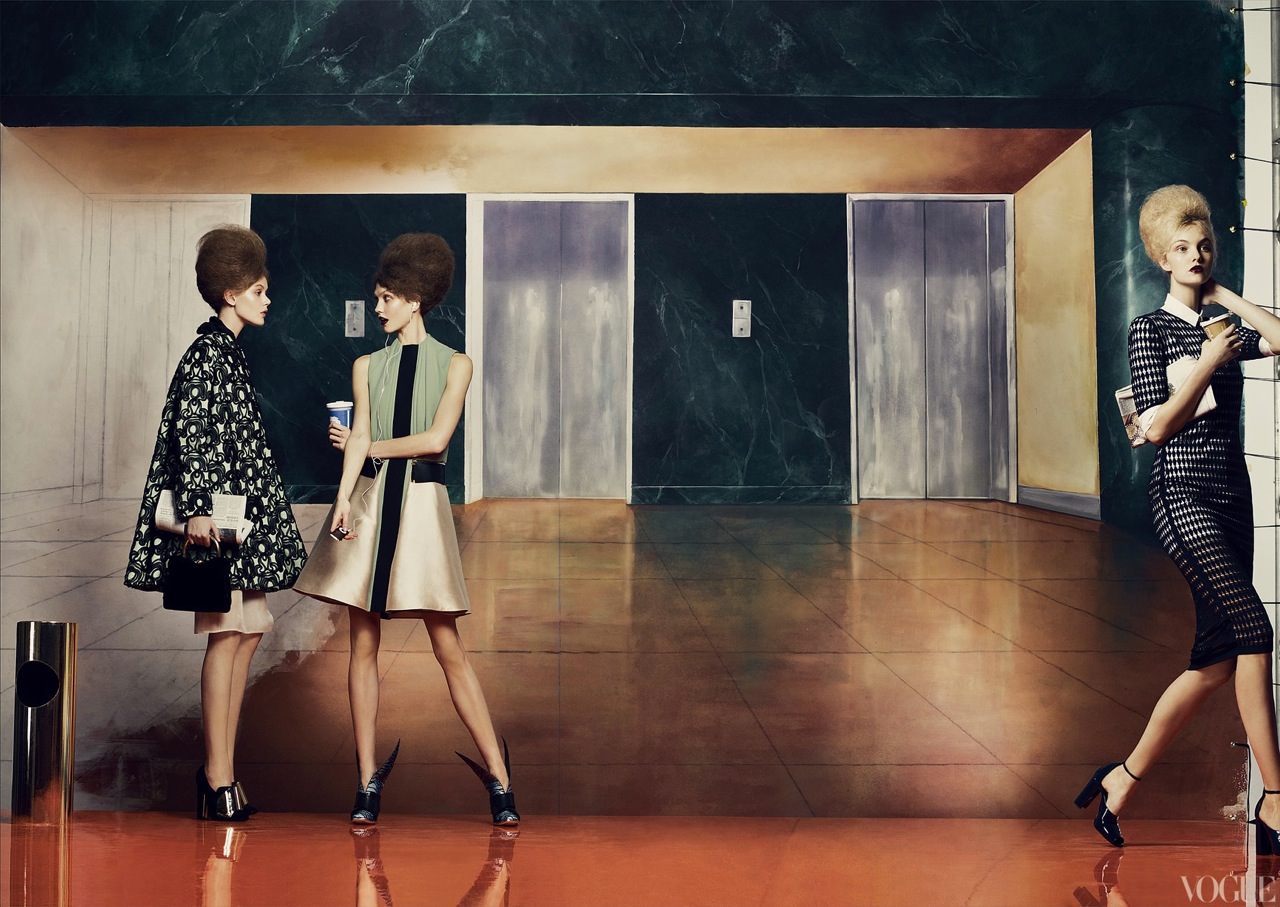
Having been told our constructed fashion image needed to involve contemporary fashion we tried to source clothing from certain retailers in the high street which were based on catwalk styles. We also had some guidance in the form of the following photos to help us find the right outfit for our image.


We can see that the general similarities in these images are long skirts and high necklines and collars. As well as this, there are a lot of neutral tones with some bright reds and blacks but not too much of a variation in colour.

***

While other members in the group were using this as inspiration, I decided to research what the current top trends on the catwalk were and look for clothing on the high street that related to these but which also fit with the classic 50s style; tying in the original with the contemporary to create a generally modern look.

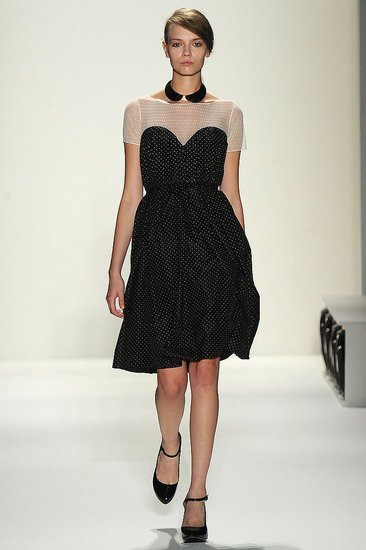
The top few trends of New York Fashion Week (Spring 2012) are bird prints and sheer fabrics of which I found a surprising amount of while out looking. I was also keeping an eye out for the 50s style showing through in modern clothes. Some of the following photos are what I found...


The bird print vests are both very modern styles, however, similar clothes were also found in the 50s - collars, sleeveless, and ties at the hem. They are also made from sheer fabrics. The sheer skirt is knee length as they wore in the 50s. The dress is over the knee and fitted which shows off the woman's figure. This is known as a "wiggle" dress and originated from the 50s. They would also wear short jackets with three quarter length sleeves and I saw a lot of these in the shops I visited, some with round collars.

***

As well as this, while working with my group, I found relevant contemporary dresses mimicking the styles on the catwalk such as:


Wednesday, 16 May 2012

Fashion: Constructed Image: Process of Visual References

We began creating mood boards based around the category of "Film" during the first week of having the assignment. These depicted scenes of films we admired the lighting choices of, examples of film noir, some of Tim Walker's fashion sets, strange and interesting rooms, the theme of exploration which particularly interested Joe Earley, photos of collections I found particularly interesting and some elaborate and even gothic make up styles. Generally, aesthetics we desired.


We displayed these mood boards and talked about them as a group. We discussed going for a similar look to the rooms in the last mood boards - we liked the extravagance and the vibrant colours. We also like Tim Walkers fashion influence upon our mood boards and thought we could work with something like this.

However, upon having differing opinions we began to talk about a set split between a modern and colourful look and a more subtle traditional feel. One of the suggestions was creating a room directly split in half, each half showing a very different picture as well as the model being styled very differently on each side of the body. Two things came from this: the idea of duality, and a reference (Dark City) dealing with the notion of two opposites residing together.

Due to this influence, we then narrowed down our ideas and came up with revised mood boards depicting the psychological aspects of films which also exhibited the idea of duality such as Blue Velvet, Donnie Darko and Fight Club. We also started thinking about the American Dream after exploring films like Blue Velvet and American Beauty thinking about the notion of duality within them.


After this we decided to work with the idea behind the American Dream and focus on the facade behind it. How everything seems perfect but behind closed doors it is a very different story. We thought about what would be involved in our set f we went down this route. We decided fairly early on that we would build a dining room, and have a female model who would be the housewife looking after the home. We created more mood boards from this point focussing more on fashion and character and also the period of the 50s and what the home would look like in this decade. The look of the model became important as we decided we wanted a false look; doll like and awkward.


After this we considered the composition of our photograph and what would be included. Originally we wanted a whole family around the table. However we realised this would cause more difficulties due to sourcing the right models and especially because children would be involved as well as possibly crowding the image.


We then considered the use of mannequins to reinforce the awkwardness and doll-like look to contribute to the false perfection behind the concept of the American Dream. From this we ended up researching the aesthetics of the Nuclear Towns designed for experimentation and analysis of the effect of nuclear bombs in which mannequins were used.


These are what we used as our final visual references to achieve the right aesthetics for our concept having developed from all the influences we had from the beginning and honed in on what we felt was strong. We tried to make our set look like a real home, just as the nuclear homes were designed t seem real and why mannequins were placed within. Having been unable to source a mannequin we directed our model to seem fake, like a doll or a mannequin with awkward limbs and a strange posture with a distant gaze.

As well as this, we wanted to involve the outside with the interior and we used these photographs as inspiration and references for creating a similar look in our set with the juxtaposition between this strange occurrence - sand entering the house from the desert with what is seemingly normal and everyday life for the housewife.


Thursday, 5 April 2012

Fashion Constructed Image: Progress

Concept summary: The dark side of the American Dream.

After having many meetings about our narrative and the construction of our set, our concept has developed further towards the breakdown of this perfection.

Changes we have made:

  • Rather than use a nuclear family in our set in the sense of a mother, father and two children, we are taking this into the nuclear homes context where there is the notion of destruction and futility.
  • We thought about the use of mannequins rather than real people to make up the family but having not been able to source any and and testing how our set build would look with 4 characters, we realised this looked too crowded and took away the desired simplicity.
  • We originally decided to build and shoot a clean, simple set. Now we are considering the incorporation of sand into our set blowing in from the desert outside. This will tie in this perfect American Dream with the nuclear towns built only for one purpose.
  • We have decided to involve a window and an open door in our image to provoke the feeling of looking in and also to contextualise our photo.